
Bathroom Surface Materials: What Lasts, What Fails, and What Drives Your Renovation Cost
Surfaces are where most bathroom renovations get quietly undone. Not the tiles themselves — the decisions made about them before a single one goes on the wall. Wrong slip rating. Wrong substrate. Wrong sequence. By the time water shows up behind the skirting board two years later, the bathroom looks fine. The problem is invisible until it isn’t.
Why Surface Selection Is a Structural Decision
Selecting a bathroom surface feels like an aesthetic decision. You’re looking at finishes, colours, textures. What you’re actually doing — whether you know it or not — is making choices about your waterproofing system.
The tile you specify for your shower floor determines which Australian Standard applies, what slip resistance is legally required, and how the membrane beneath it needs to be installed. Change the tile format and you may change the substrate preparation requirements. Specify a frameless shower screen and you’ve expanded the zone that needs full wall waterproofing coverage. These are not separate decisions. They are the same decision made at different points in the project.
This matters for one practical reason: mistakes made at the surface selection stage tend to be expensive to fix later. Waterproofing failures — where the membrane under the wrong surface type was either under-specified or incorrectly applied — are one of the most common sources of hidden water damage in Australian bathrooms. The surfaces look fine. The damage is happening behind them.
A surface that performs well is one that was chosen in the context of the full build. Not from a catalogue.
Related: Before specifying any surface, confirm which AS 3740 zones apply to your bathroom layout and what waterproofing coverage is required under each. See the AS 3740 waterproofing compliance guide ›
Six Categories. Very Different Compliance Profiles.
Not all surface decisions carry the same weight. Getting your grout colour wrong is annoying. Getting your shower floor slip rating wrong is a builder defect. Here is what each category actually controls.
The primary compliance zone. Slip resistance rating (P-rating) is a legal requirement in wet areas under AS 4586 — not a product spec you can bypass. Material, format, and finish all affect the waterproofing system beneath.
Less compliance-critical than floor tiles, but format and finish choices affect maintenance burden and grout strategy significantly. Feature wall placement affects how the renovation ages visually over a decade.
Acrylic, laminate, and PVC-backed systems installed in place of wall tiles. Faster to install, fewer grout joints to maintain. Not a substitute for correct substrate preparation and waterproofing behind them.
Engineered stone, natural stone, acrylic, laminate. Material choice directly affects longevity in a wet environment. Some materials require ongoing sealing. Some fail without adequate ventilation above them.
Frameless, semi-frameless, framed. Glass specification, junction waterproofing, and hardware finish all sit here. Safety glazing compliance under AS/NZS 2208 is mandatory regardless of frame configuration.
Overlooked at the brief stage more often than any other category. Moisture-resistant ceiling finishes and adequate exhaust ventilation directly affect the performance of every surface category above.
Floor Tiles: Slip Ratings Are Not Optional
A homeowner in the Hunter Valley discovered that the tiler their builder used had installed wall-rated tiles on the shower floor. Not because anyone was cutting corners deliberately — because nobody on the project had checked. The tiles looked right. Same colour family as the wall tiles, same format, cheaper per square metre. It wasn’t until the builder’s defects period was ending that anyone thought to ask.
The fix — strip out the shower floor, re-waterproof, re-tile — cost more than the original tiling job. That scenario plays out more often than the industry admits.
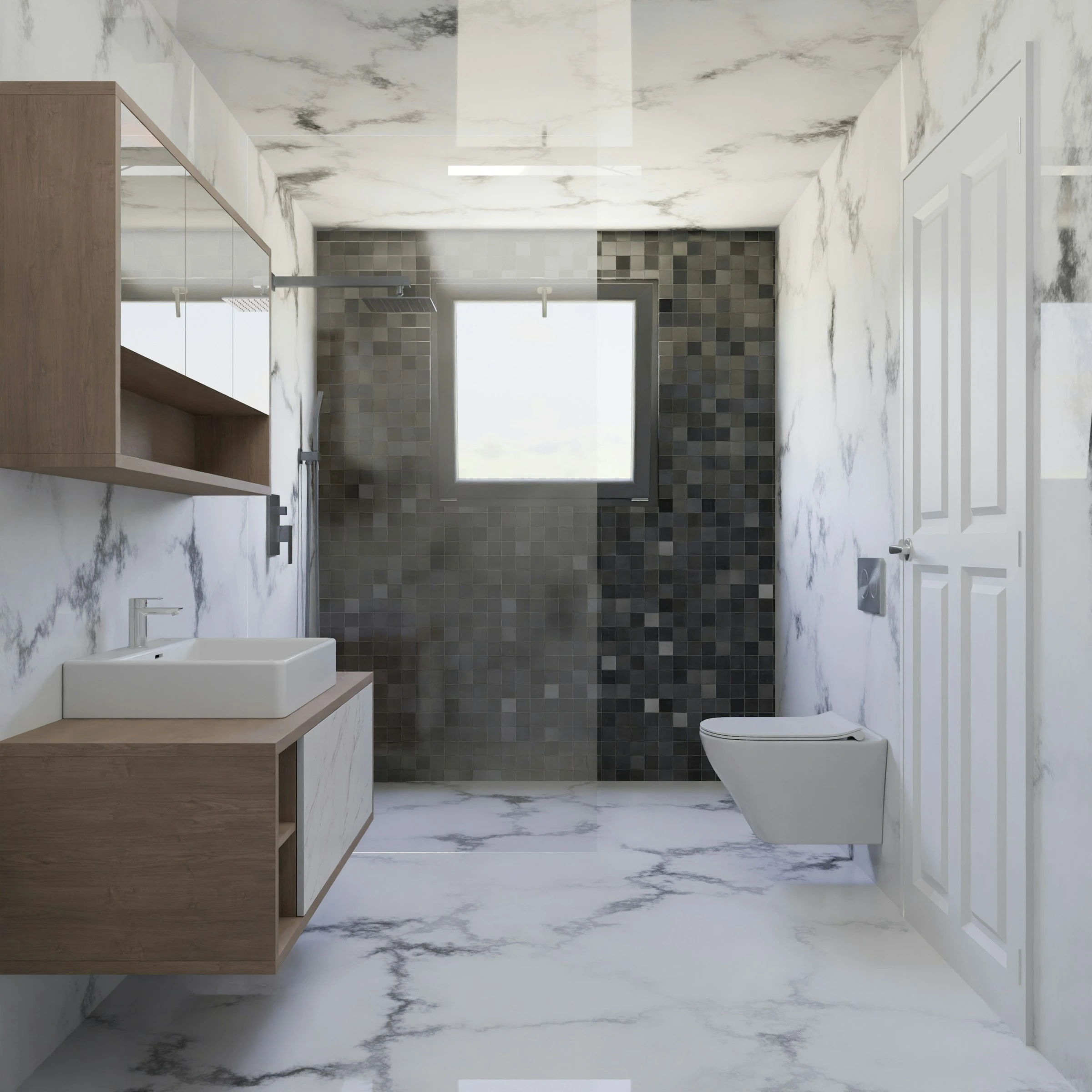
Slip Ratings
Under AS 4586, all pedestrian surfaces in wet areas must meet minimum slip resistance classifications. For general wet bathroom floors outside the shower recess, P3 is the minimum. For shower recesses and wet areas subject to barefoot use with water present, P4 applies.
This is not a preference. It is a compliance requirement that a licenced tiler should already know. If you are specifying your own tiles, the slip resistance classification will be on the product data sheet. If it isn’t listed — or if the supplier cannot confirm it — that tile is not for your shower floor.
Porcelain vs Ceramic
Porcelain is denser, less porous, and more durable than ceramic. In a wet area subject to daily use, that density matters — both for surface wear and for moisture absorption at the body of the tile rather than just the glaze. Ceramic is cheaper and easier to cut, which is why it turns up frequently on budget renovations. It is not wrong for a bathroom, but it is less forgiving if the waterproofing underneath is imperfect.
Large-Format Considerations
Large-format tiles — 600×600mm and above — read as more premium and reduce visible grout lines. Fewer grout lines means fewer potential waterproofing failure points at the surface level. The trade-off is that large-format tiles require a flatter, more rigid substrate. Any flex or variation in the subfloor that would be manageable under smaller tiles becomes a cracking risk under large format.
Confirm your subfloor specification before committing to a large-format floor tile. The tile supplier won’t ask. The tiler might not raise it until they’re already on site.
Grout Line Width and Fall
Shower floors require a fall to the drain — typically 1:80 under AS 3740. Tile format, grout line width, and drain position need to be resolved together before layout is set. Getting this sequence wrong is how you end up with pooling water and a bathroom that technically drains but never feels dry.
Important: Non-compliant slip rating in a wet area shower floor is a builder defect — not an aesthetic issue. If your renovation is inside its statutory warranty period and the wrong P-rating was installed, your licenced builder has an obligation to rectify it. See contractor licensing guide ›
Wall Tiles: Format, Finish and Grout Strategy
Wall tiles carry less compliance weight than floor tiles, but they carry more of the aesthetic weight — and more of the long-term maintenance burden. The decisions made here tend to stick around for fifteen years.
Matte vs Gloss
Gloss tiles amplify light and make smaller bathrooms feel larger. They also show water marks, soap scum, and fingerprints clearly — particularly in hard water areas. Matte finishes are more forgiving in daily maintenance but can retain soap residue in the texture over time if not cleaned consistently. Neither is objectively better. The right answer depends on your water quality, your maintenance habits, and your lighting.
Large Format on Walls
The same structural logic applies on walls as on floors — large-format tiles require a flat, well-prepared substrate. On walls, this means variations need to be checked and addressed before tiling starts, not after. A large tile across an uneven wall looks worse than a smaller tile would. The scale magnifies every imperfection.
Fewer grout lines on a wall also means fewer potential points of movement or moisture ingress at the surface. In a high-splash zone adjacent to the shower, that is worth factoring into the specification.
Grout Strategy
Grout colour is a decision most homeowners make at the last minute. It shouldn’t be. Light grout in a dark tile bathroom creates a grid effect that dominates the room. Dark grout on light tiles hides staining better but can make a small bathroom feel heavier. Matching grout to the tile colour produces the cleanest, most contemporary result — and is the hardest to maintain without discolouration over time.
Grout is not a sealant. It is a joint filler. Waterproofing happens below the tile layer, not between them.
Related: Grout is not a sealant — it is a joint filler. Waterproofing happens below the tile layer, not between the tiles. See AS 3740 waterproofing compliance guide ›
Wet Area Panels: When Tiles Aren’t the Answer
Acrylic panels, laminated systems, and PVC-backed boards have carved out a genuine market in Australian bathroom renovations over the last decade. Faster to install than tiles, fewer surface joints for moisture to penetrate, and significantly less ongoing grout maintenance. They are not a second-rate option. But they are not a fit for every renovation.
Where Panels Work
In a rental property ensuite where durability, low maintenance, and quick installation matter more than premium presentation, panels are a rational choice. In a bathroom with a tight completion window — a rental between tenancies, a project with overlapping trades — the faster install timeline is a real advantage. Budget renovations where tile and waterproofing labour would consume most of the contingency often make better use of panels than tiles.
Where They Don’t
In a high-end owner-occupied renovation, panels tend to affect resale perception. Buyers at the premium end notice them. In a steam shower or spa bath application where heat and humidity are sustained over extended periods, the performance of panel systems varies considerably by product — check the manufacturer’s specifications carefully before committing.
The other limitation is design flexibility. Tiles can be cut and formatted to accommodate complex geometry, feature walls, and multi-zone layouts. Panel systems are less adaptable.
The Compliance Misconception
Panels are a surface layer. They are not a waterproofing system. Regardless of which panel product is specified, the substrate behind it must still be correctly prepared and a compliant membrane installed where AS 3740 requires one.
This is probably the most common misconception in this category — that installing a panel system removes the need for waterproofing behind it. It doesn’t. The panels protect you from surface moisture. The membrane protects you from the water that gets around the panels.
Benchtop Materials: Durability in a Wet Environment
The most common benchtop failure in Australian bathrooms isn’t stone cracking or acrylic discolouring. It’s timber veneer delaminating because nobody confirmed whether the exhaust fan was adequate before the spec was set. A material that performs beautifully in a well-ventilated bathroom can fail inside three years in one with inadequate air exchange. Before choosing a benchtop material, confirm ventilation is part of the renovation scope.
Here is how the main options compare:
| Material | Cost Tier (Supply) | Durability | Maintenance | Risk Level |
|---|---|---|---|---|
| Engineered stone | $600–$2,200+ | High | Low — wipe clean, no periodic sealing required | Low. Most forgiving material in a wet environment. |
| Natural stone | $900–$3,500+ | High if sealed | Medium — periodic sealing required; frequency depends on stone type and use | Medium. Unsealed natural stone absorbs moisture and cleaning products. |
| Acrylic | $300–$900 | Medium | Low — avoid abrasive cleaning products | Low. Lighter weight; more susceptible to surface scratching. |
| Laminate | $200–$700 | Low–Medium | Low until failure | High in bathrooms. Moisture infiltration causes delamination — especially at joins. |
| Concrete (bespoke) | $1,200–$4,000+ | High if sealed | High — sealing required; surface sensitive to acids and abrasives | Medium-High. Heavy; requires structural floor loading assessment before specification. |
Supply-only figures. Installation, templating, and plumbing connection are additional costs. See the full bathroom renovation cost guide ›
Shower Screens and Glass
Shower screen selection is where aesthetics and compliance intersect most visibly. The screen is one of the most prominent elements in the bathroom. It is also a structural component in the waterproofing system at the junction between the glass panel and the tiled surface.
Configuration
Frameless screens — no metal frame around the glass perimeter — are the most popular choice in contemporary Australian renovations. They require a minimum 10mm toughened glass panel and produce cleaner junctions with adjacent tile work. Semi-frameless screens use a partial aluminium channel at the top and base, and can be specified with 6mm or 8mm glass. Framed systems are the most economical option and the easiest to replace — they are also the least popular aesthetically at the moment.
Glass Specification
All glass used in shower screens must comply with AS/NZS 2208 — the safety glazing standard. Toughened safety glass is the baseline. Laminated safety glass provides an additional layer of protection if a panel is broken, as the inner laminate holds the fragments together rather than scattering them. For installations with young children or elderly occupants, laminated glass is worth specifying beyond the compliance minimum.
Safety Compliance
AS/NZS 2208 is not a premium upgrade. It is a mandatory standard. If a quote for a shower screen doesn’t reference safety glazing compliance, ask directly. An unspecified screen that fails under impact creates both injury risk and liability exposure that a standard home insurance policy may not cover.
Finish Matching
The hardware on the shower screen — hinges, handles, channel — needs to match the tapware finish specified elsewhere in the bathroom. This is where finish decisions made earlier in the project come back. Chrome tapware with brushed brass screen hardware reads as unfinished, even in a well-specified bathroom. Confirm the screen hardware finish at the same time as the tapware. Not after the tiles are grouted.
Related: All shower glass must comply with AS/NZS 2208 safety glazing standard — not optional, not a premium upgrade. Confirm compliance before ordering. See bathroom fixtures and fittings guide ›
Cost Tiers by Surface Category
These are supply-only reference ranges. They exist for one purpose: to help you identify when a renovation scope is being cut short, or when a budget allowance is so far below market that something is missing from the specification. If your total renovation quote is $22,000 and the combined tile allowance is $800, someone has made a decision they haven’t told you about.
| Surface Category | Indicative Supply Range (AUD) |
|---|---|
| Floor tiles — porcelain, per m² | $35 – $180+/m² |
| Wall tiles — ceramic or porcelain, per m² | $25 – $150+/m² |
| Wet area panels — acrylic or laminate, per m² | $45 – $130+/m² |
| Engineered stone benchtop — per linear metre (supply only) | $600 – $2,200+/lm |
| Shower screen — frameless, supply only | $800 – $3,500+ |
| Safety glazing laminate upgrade — per panel | $150 – $600+ |
Installation, waterproofing labour, substrate preparation, and tiling are additional costs and represent a significant share of total renovation spend. Full bathroom renovation cost guide ›
Not Sure Which Surface Spec Fits Your Project?
Tell us about the bathroom. We’ll give you a straight answer on scope and spec level — no obligation, no sales pitch.
Lifestyle Bathrooms is a referral and connector service, not a licenced contractor. We connect homeowners and property professionals with vetted bathroom renovation specialists across NSW and ACT.
Common Mistakes With Surface Selection
The most expensive mistake is also the most preventable. Specifying floor tiles without confirming their P-rating for wet areas happens on renovations with experienced builders, not just DIY jobs — because nobody on the project checked, and the product data sheet was never requested.
Large-format tiles on a subfloor that hasn’t been assessed for deflection produce a specific failure pattern. The tiles look perfect at handover. A year later, there’s a hairline crack running through the third tile from the wall and a grout joint that has started to open. The crack isn’t structural — but it is a pathway for water to reach the membrane, and then the substrate, and then the ceiling of the room below. By the time that shows up as a water stain, the damage is already done.
Specifying a timber veneer benchtop without confirming adequate exhaust ventilation first.
Using wall-rated tiles on a bathroom floor is one of the more common errors on fast-turn or budget renovations. Wall tiles carry no slip resistance classification and are not rated for foot traffic under load. Installing them on the floor is non-compliant in a wet area. It is a defect — not an oversight that can be papered over with a coat of sealer. Replacing them means stripping out the floor, re-waterproofing if the membrane was disturbed, and re-tiling. The cost of that rectification is rarely absorbed quietly.
Mixing grout widths across zones without a layout plan. The shower floor has 2mm joints because the tile is rectified. The main bathroom floor has 5mm joints because it isn’t. On a well-considered renovation, this reads as intentional. On most of the bathrooms where it happens, it doesn’t.
Important: Surface mistakes are often invisible until water is already tracking behind the wall. By then, the cost is not in the tiles — it is in the strip-out. Common waterproofing shortcuts › | Renovator red flags ›
Maintenance Requirements by Surface
The best surface for a bathroom is one you’ll actually maintain. Not the most premium option available — the one that fits how the bathroom is used, who uses it, and how much time is realistically going into its upkeep.
Grout and Tile
Grout should be sealed after installation and resealed every two to three years, depending on use and water quality. Epoxy grout requires no sealing and resists staining better than cement-based alternatives. It is harder to apply during installation, which is why some tilers avoid specifying it without being asked. For high-use bathrooms or rental properties, the long-term maintenance saving justifies the upfront premium.
Stone Surfaces
Natural stone benchtops require sealing at installation and periodically thereafter. Frequency depends on the stone type and how actively the bathroom is used. Unsealed natural stone absorbs moisture and cleaning products, which stains and weakens the surface progressively over time. Engineered stone does not require sealing but should not be cleaned with acidic or abrasive products — both will damage the resin binders that give the material its durability.
Glass
Anti-limescale coatings on shower screens reduce maintenance significantly, particularly in hard water areas. A coated frameless panel cleaned weekly will outlast an uncoated panel cleaned monthly. If your renovator or screen supplier offers a hydrophobic coating application at installation, it is worth including in the initial specification rather than applying it retrospectively.
Panels
Wet area panels require less maintenance than tiled surfaces but are not maintenance-free. Panel-to-panel joints and the silicone sealant line at the base need to be checked annually. Silicone that has failed at a panel joint is a direct moisture pathway behind the panel — which defeats the purpose of choosing panels over tiles in the first place.
What Not to Use
Bleach-based cleaners on natural stone. Acidic cleaners on engineered stone. Abrasive scrubbing pads on PVD-coated tapware or matte-finish tiles. These are not cautious suggestions — they are the fastest ways to void a product warranty and damage a surface that cannot be spot-repaired. Check cleaning product compatibility with your supplier before the bathroom goes into use. Maintenance hub ›
Common Questions
The minimum P-rating under AS 4586 depends on the application. P3 applies to general wet bathroom floors outside the shower recess. P4 is required for shower recesses and any wet area subject to barefoot use with water present. The P-rating should be stated on the product data sheet — if it isn’t listed, the tile has not been tested for slip resistance and should not be installed on a wet area floor.
Not in a wet area. Wall tiles are manufactured and tested for vertical surface applications — they carry no slip resistance classification and are not rated for foot traffic under load. Installing wall tiles on a wet area bathroom floor is non-compliant under Australian standards and constitutes a builder defect. A licenced tiler who installs wall tiles on your shower floor is installing a non-compliant surface, regardless of how the product was labelled at the point of purchase.
This is probably the most widely misunderstood thing about panel systems. Panels are a surface layer — they are not a waterproofing membrane, and they do not remove the obligation to waterproof the substrate behind them. Under AS 3740, the required waterproofing zones in a bathroom are defined by the construction itself: the presence of moisture, the proximity to water sources, and the type of wet area. A panel installed over a substrate that hasn’t been correctly waterproofed is still a non-compliant installation. Moisture will find its way behind the panel through joints, fixings, and the base sealant line — particularly once the silicone starts to age. The cost of rectifying a waterproofing failure behind panels is the same as rectifying one behind tiles. Neither surface protects you from the substrate failing underneath it.
Rectified tiles are cut after firing to achieve precise, consistent dimensions across every tile in the batch. This allows very narrow grout joints — typically 1.5–2mm — and is required for most large-format installations. Non-rectified tiles have slight dimensional variation across the batch because they are not cut after firing; they need wider joints, typically 3–5mm, to absorb that variation. Using non-rectified tiles with narrow grout lines produces lippage — where adjacent tile edges don’t sit level with each other — which cannot be corrected without re-tiling.
Depends on the ventilation. Engineered stone is durable, low-maintenance, and performs well in a bathroom with adequate exhaust ventilation and normal daily use. In a poorly ventilated bathroom where humidity sits for extended periods, the adhesive bond between the stone and the cabinetry can be affected over time — less common than with laminate, but not impossible. Confirm that adequate exhaust ventilation is part of your renovation scope before specifying any stone benchtop, engineered or natural.