
Bathroom Grout and Sealants: Types, Application and What Happens When It’s Done Wrong
Grout and sealant are not glamorous. Nobody puts them on a mood board. But between them, they’re responsible for whether water stays inside your shower or ends up behind your tiles — and they’re also the two materials most commonly skipped, rushed, or incorrectly applied on jobs where someone was cutting costs.
Here’s what you need to know before your renovation starts.
Grout and Sealant Are Two Different Materials. They Do Two Different Jobs.
People use these terms interchangeably. That’s understandable — both end up between tiles, both get applied with something that looks like a gun at some point, and once they’ve cured they don’t look that different from across the room. But they’re not the same thing, they’re not interchangeable, and using one where the other is required is a compliance issue, not just a quality preference.
Grout fills the joints between tiles. It bonds to both tile edges, creates a rigid fill, and — depending on the type — may or may not require sealing afterwards. It completes the tiled surface.
Sealant — specifically flexible silicone or polyurethane sealant — creates a waterproof, flexible barrier at movement joints: bath to wall, floor to wall, wall to wall at internal corners. Anywhere the building moves fractionally. Anywhere grout would eventually crack.
Why does the distinction matter for your renovation? Because renovation quotes frequently don’t separate them clearly. A tiler’s scope might say “grout and seal” and mean two completely different things to two different people reading it. If you don’t know which is which, you can’t ask the right questions before you sign off.
Related: Before specifying any grout or sealant, confirm what wet area waterproofing compliance your renovation requires. See our AS 3740 waterproofing compliance guide ›
Three Types of Grout. Very Different Use Cases.
Not all grout is equal — and the wrong choice for a given installation isn’t just an aesthetic problem. Here’s what each type actually does, and where it belongs.
The most common type in residential bathrooms. Comes in sanded (for joints 3mm and wider) and unsanded (for joints under 3mm, or on polished tiles where sand particles would scratch the surface). Porous once cured — absorbs water without a penetrating sealer applied on top. For most standard tile installations, this is the right call. Predictable, widely available, and every competent tiler has installed it thousands of times.
Two-part product — resin and hardener mixed before application. Extremely hard-wearing, chemical-resistant, and non-porous, which means it doesn’t need sealing. Significantly more expensive in both product cost and labour. Used in commercial kitchens and high-traffic wet areas for good reason. In a residential bathroom, worth specifying where heavy use, harsh cleaning products, or genuine low-maintenance requirements make the premium worthwhile.
Polymer-modified cement grout sits between the two above — more flexible than standard cement grout, more resistant to cracking at stress points. Purpose-built for heated floors, large-format tiles, and installations where some substrate movement is expected. Furan and polyurethane specialist grouts exist for industrial applications. Unlikely to be relevant for a standard residential bathroom unless the brief genuinely calls for it.
Why Most Bathroom Grout Needs Sealing — and What Happens When It Doesn’t
Cement-based grout is porous. Once it’s cured and cleaned, it will absorb water and anything else that gets on it unless a penetrating sealer is applied. That’s not a defect — it’s just what the material does.
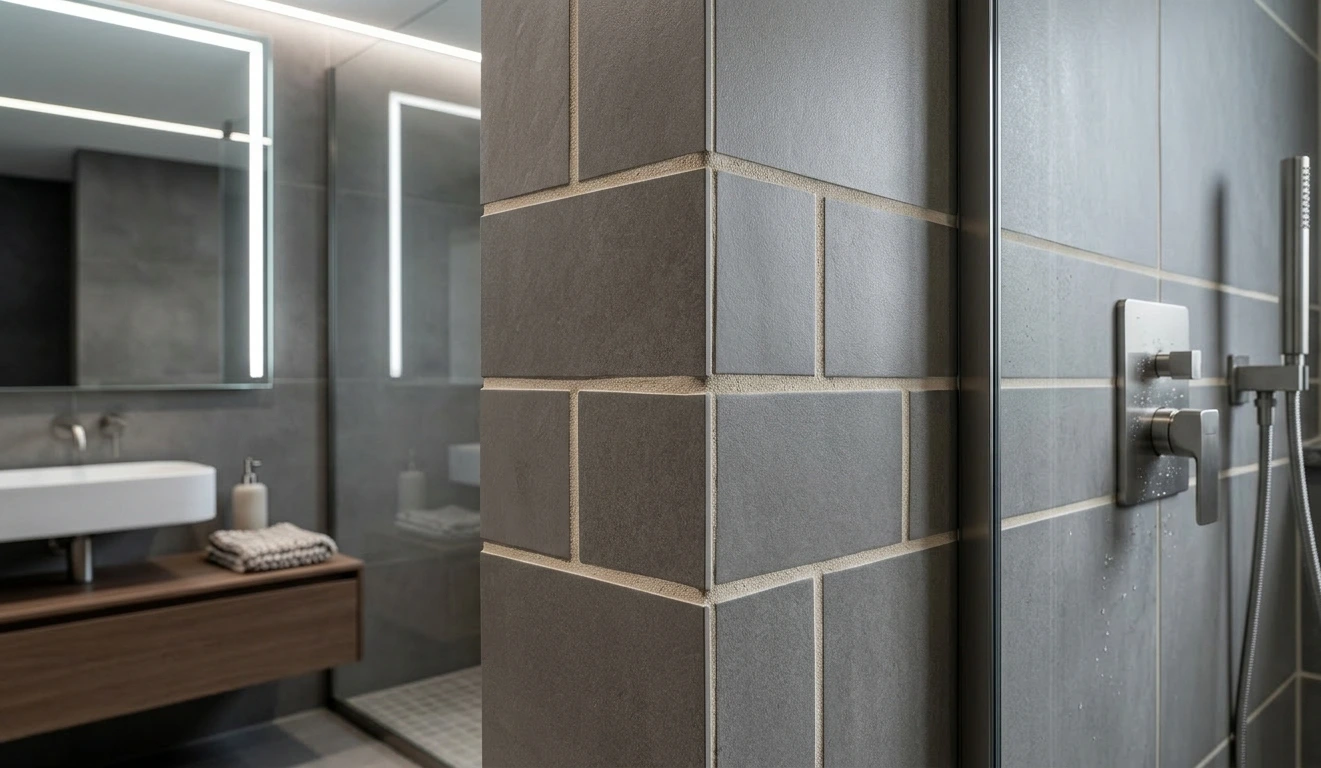
Before sealing
Some tilers apply a grout release agent before grouting on natural stone or unglazed tiles — to stop the grout staining the tile face during application. This is a separate step to sealing the finished grout. Know the difference before you sign off on a specification.
Sealed correctly, cement grout resists water absorption, staining, and the mould growth that follows trapped moisture. Skipped entirely, you’ll notice discolouration and mould within a few months. Faster in a poorly ventilated bathroom. Faster again in a household with heavy shower use.
Re-sealing and testing
Grout sealant isn’t permanent. Penetrating sealers in a shower typically last 3–5 years before they need reapplication — in a bathroom with lower traffic and better ventilation, you might stretch to 7. The test is simple: put a few drops of water on the grout. If it beads, the sealer is working. If it absorbs, reseal.
Epoxy is the exception
Epoxy grout doesn’t need sealing. The non-porous matrix means water has nowhere to go. If someone is quoting you a sealing step on an epoxy grout installation, it’s worth asking why.
Where Sealant Goes — and Why the Wrong Type in the Wrong Place Is a Problem
Grout and silicone look similar from a metre away. The difference matters enormously at the junctions where your bathroom is most vulnerable to water getting in.
Silicone sealant
Flexible, waterproof, and designed to move with the building. It goes at every internal corner in a wet area — floor-to-wall, wall-to-wall at internal corners, bath-to-wall. These joints move seasonally, as the building settles, as the substrate expands and contracts with temperature. Grout doesn’t accommodate that movement. Silicone does.
Polyurethane sealant
More rigid than silicone and more paintable. Used more commonly in external applications and wet areas outside the immediate shower zone. Not generally the first choice at bath or shower junctions — silicone handles those better.
Acrylic sealant
Water-based and paintable, but significantly less flexible than either of the above. Not appropriate for fully wet areas. Its use in a bathroom should be limited to genuinely dry zones where paintability is the priority. It has no business in a shower enclosure or at a bath junction.
Important: One of the most common renovation shortcuts: grout used at movement joints where silicone sealant is required under AS 3740. The bath-to-wall junction is the classic failure point. Grout there will crack — not if, when. Water gets behind the tiles, and you won’t see the damage until it’s significant. See common waterproofing shortcuts ›
Matching the finish
Silicone sealant comes in a wide colour range. It should match your grout — or be deliberately contrasted as a design choice. What it shouldn’t be is an afterthought. Sealant colour is a specification decision. If it’s being decided on site on the last day of the job, it’s being decided too late.
Grout Colour Is a Design Decision and a Maintenance Decision
The two don’t always point in the same direction.
Dark grout on light tiles looks clean and contemporary and hides soap residue and water marks well. It also shows calcium deposits and mineral efflorescence more clearly than light grout does — and in areas with hard water, that matters more than people expect when they’re choosing a colour from a small swatch.
Light grout on dark tiles creates strong contrast that reads as deliberate. It also shows every mark. High-gloss tiles amplify this — any residue on the tile face draws the eye immediately to the grout joints, which compounds the effect.
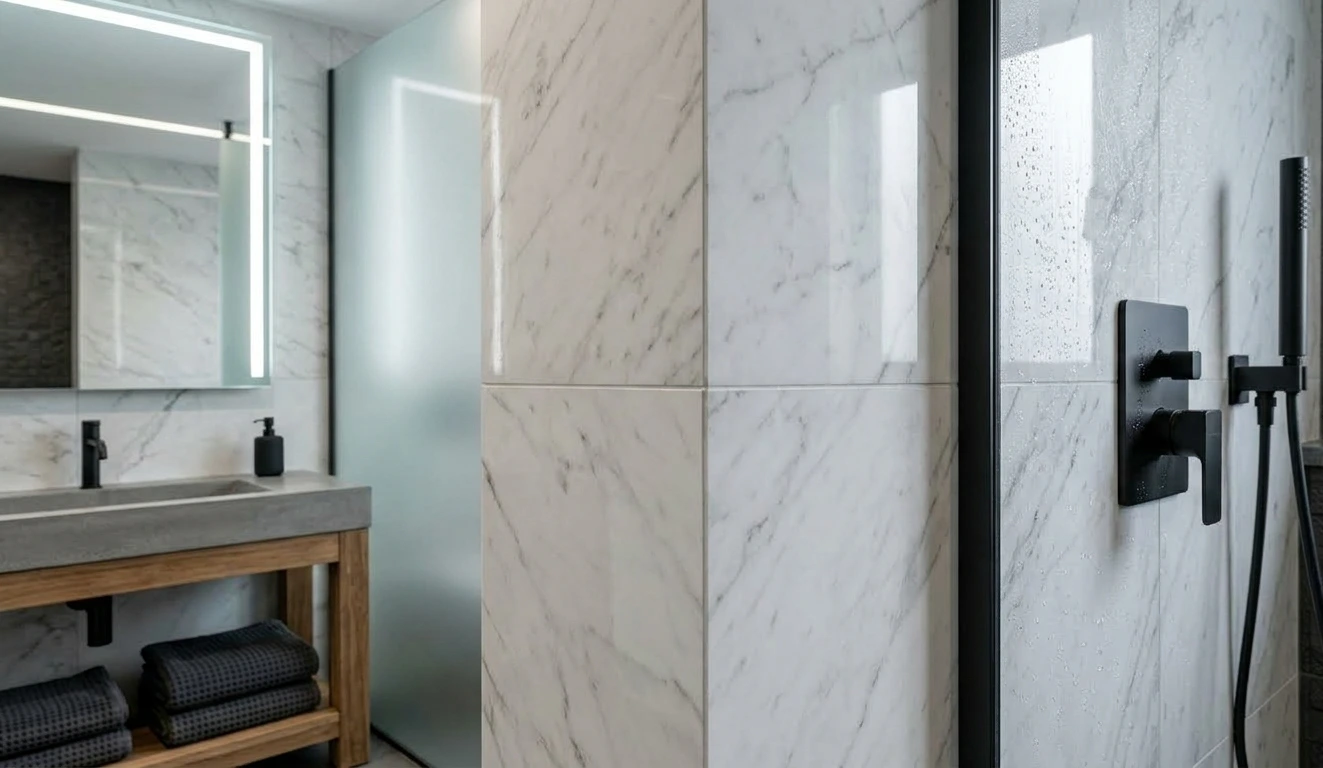
Joint width and rectified tiles
Rectified tiles — cut to precise dimensions with no edge variation — allow for very narrow grout joints: 1–2mm. That can look exceptional in the right application. It also means any movement in the substrate becomes a grout crack rather than an absorbed joint movement. Worth knowing before you commit to the narrowest possible joint width.
Polished surfaces and grout haze
Polished tile surfaces are less forgiving if grout residue isn’t cleaned off promptly during installation. It hazes. The window to clean it is short — often a matter of hours depending on the grout type and temperature. Your tiler should flag this when you’re specifying polished tiles. If they don’t mention it, ask.
What Grout and Sealant Work Costs in NSW and ACT
Grout and sealant materials are low-cost relative to tiles, fixtures, and waterproofing membranes. The labour to apply them correctly — and especially to redo them when they’ve failed — is where costs accumulate.
| Item | Indicative Range (AUD) |
|---|---|
| Cement-based grout (supply) | $15–$45 per bag — covers 3–8m² depending on joint width and tile size |
| Epoxy grout (supply) | $80–$180 per kit |
| Silicone sealant (supply) | $10–$25 per tube |
| Grout sealer (supply) | $25–$70 per 500ml |
| Re-grouting labour | $40–$90/m² depending on access and existing tile condition |
| Full re-grout + reseal — standard bathroom | $600–$2,200 depending on scope and condition |
| Emergency silicone replacement — bath junction | $150–$400 per junction |
These are indicative ranges, not quotes. Labour varies significantly with scope, access, and existing substrate condition. See our full bathroom renovation cost guide ›
Not Sure What Your Renovation Needs?
Tell us about the bathroom. We’ll give you a straight answer on scope and specification — no obligation, no sales pitch.
Lifestyle Bathrooms is a referral and connector service, not a licenced contractor. We connect homeowners and property professionals with vetted bathroom renovation specialists across NSW and ACT.
The Grout and Sealant Failures That End Up Costing Real Money
Most grout and sealant problems don’t announce themselves. They develop quietly behind tiles and under substrates until the damage is significant enough to show through — at which point the repair bill is usually several times what the original correct application would have cost.
Cracking grout at movement joints
The most common failure, and the most preventable. Cement grout was used at a junction where silicone was required. The bath shifts fractionally as it fills with water. The floor expands with temperature. A rigid material in a flexible joint cracks. Water finds the gap. From there, the timeline depends on how much water use the bathroom sees — but the damage is already starting.
Grout shrinkage
Cement grout mixed with too much water, or applied in thin sections at the tile edge, can shrink as it cures. Small gaps open along the tile edge. Not structural on day one. Becomes structural once water gets repeated access — and in a shower, it will.
Silicone discolouration and mould
Surface mould on silicone — the black spotting along a sealant line — is generally a ventilation and cleaning issue. Moisture sits on the surface, spores take hold. Regular cleaning and better air circulation usually address it. Quality silicones with anti-fungal additives slow it down.
Mould growing through the sealant is different. That means water is getting behind the sealant, not just sitting on it. Cleaning the surface won’t fix that. The sealant needs to come out, the joint needs to be inspected, and it needs to be redone properly.
Failed sealant at the bath-wall junction
Among the more expensive repairs in a domestic bathroom. Water tracks down behind the bath and sits on the floor structure — or the ceiling of the room below. By the time it’s noticed, there’s frequently structural damage to the substrate, the framing, and sometimes the floor. Repair bills tend to start around $3,000–$5,000 and escalate depending on how long the leak has been running.
Re-grouting when the membrane has been breached
If the waterproofing membrane was compromised during the original tiling — which happens when grout is applied carelessly over a thin or poorly prepared membrane — re-grouting isn’t a repair. The tiles need to come off, the membrane needs to be assessed and redone, and everything goes back on. That’s not maintenance. That’s a renovation, billed accordingly.
Common Questions
Grout fills the joints between tiles — semi-rigid filler that bonds to both tile edges and completes the tiled surface. Sealant is a flexible waterproof compound applied at movement joints: floor-to-wall, wall-to-wall at internal corners, bath-to-wall. Different materials. Different jobs. A renovation scope that uses “grout and seal” to describe both is worth clarifying before work starts.
Cement-based grout, yes. It’s porous — without a penetrating sealer it absorbs water and staining, and mould follows. Epoxy grout doesn’t need sealing because the product itself is non-porous. If your tiler is quoting a sealing step on an epoxy installation, ask why.
For cement grout: sealer goes on once the grout has fully cured — typically 48–72 hours after application, longer in cold conditions. Re-sealing is needed every 3–7 years depending on traffic and ventilation. The water-drop test tells you when: if water beads, you’re fine; if it absorbs, reseal.
Start at the junctions, not in the middle of the tile field. Cracking or missing grout along the bath-to-wall line, at floor-to-wall corners, or around penetrations — the shower rose, the mixer — is the earliest visible sign. Grout that powders or comes away when you run a fingernail along it has lost its bond. Dark discolouration that doesn’t respond to cleaning, particularly in areas that aren’t normally wet, can indicate moisture tracking from behind the tile surface.
The harder-to-see failure: tiles that sound hollow when tapped. That usually means the adhesive bond has failed — and the reason it’s failed is typically that water has been getting behind the tile long enough to degrade the substrate. At that point, the grout is the least of your problems.
In most cases, yes — provided the waterproofing membrane underneath is still intact. A competent tiler can cut out the failed grout and re-grout without pulling tiles. The key qualifier: if the membrane has been compromised at any point — by previous water ingress, movement cracking, or poor original installation — re-grouting over it buys time, not a fix.
If there’s any doubt about the membrane, have it assessed before spending money on grout. It’s not a complicated inspection.
Two things, worth distinguishing. Surface mould — the black spotting along the sealant line — is almost always a ventilation and cleaning issue. Moisture sits on the surface, spores take hold. Regular cleaning and better air movement usually address it. Quality silicones now include anti-fungal additives that slow the process, though they don’t eliminate it entirely.
Mould visible inside the sealant — dark streaking through the material, not just on the surface — means the sealant has failed or was never properly bonded. Surface cleaning won’t fix that. The sealant needs to come out, the joint needs inspection, and it needs to be redone.